
 Got fat?
I'm sure you eat fat, but are you eating the right kind of fats to create the right ratio of fats in your body? You know, the right fat ratios to prevent chronic inflammation, cardiovascular disease and weight gain along with obesity?
Signs of Fatty Acid Imbalance
Do any of the following look familiar?
- weight gain/obesity
- chronic inflammation
- unwanted gene expression
- chronic infections or gut issues
- immune system suppression
- crave fatty or greasy foods
- history of low fat or low calorie diet
- tension headaches (base of skull)
- sunburn easily
- headaches from sun exposure
- dry or flaky skin
- muscles easily fatigued
- experience pain relief with aspirin
If some of these look familiar you've got some work to do. So read on and find out how to support shifting your fatty acid balance in a better direction.
Benefits of Healthy Fats
There is a lot of misinformation out there about healthy fats. "Fat makes you fat" is the most commonly accepted notion, but where did this actually come from? Natural and healthy saturated fats such as butter, coconut oil, cream, egg yolks, lard, cacao butter and other animal fats, have been used for thousands of years with no "fattening" effect.
The low-fat craze of the early 1990's had a huge brainwashing effect on the perception of healthy foods.
When you choose fat-free foods, you naturally choose higher sugar/higher carb and lower protein foods, because protein in its natural state comes with a healthy dose of fat. You also then eat more of these foods because low-fat equals low satiety, meaning you must eat more to get full than those who eat fat liberally.
Another major plus of eating healthy saturated fats is something called fat-soluble vitamins. They are abundantly found in healthy animal fats, and actually require fat for absorption. Vitamins A, D, E, and K are all fat-soluble vitamins that help keep your body in tip-top shape. Vitamin A specifically is actually very important for your metabolism and thyroid health, so make sure you include foods like liver, butter, and egg yolks in your daily diet.
Why we need fats:
- Healthy fat is a source of energy in the body (think of your body as a fire, fat are the logs, carbs are kindling)
- Healthy fats are required for the absorption of fat-soluble vitamins A, D, E, and K
- Healthy fats are used to construct tissue to both line and protect your internal organs
- Healthy fats are essential for a healthy liver, bile function, and the inflammatory healing process
- Healthy fats contribute to food tasting good
- Healthy fats lubricate the digestive system, and helps with removing toxins from the body
- Healthy fatty acid balance supports cell membrane health, cellular communication and reduces cellular inflammation!
So choose saturated fats like butter, coconut oil, and lard as the main fats in your kitchen. Olive oil can be a good choice in moderation, but it is not very heat stable, so it's best to use after cooking. And don't forget to eat low-mercury seafood for your omega fatty acids.
Why to Avoid Unsaturated Fats (Hint: Inflammation, Cardiovascular Disease and Weight Gain)
Unsaturated fats are also known as PUFAs (omega 6 polyunsaturated fatty acids) and are found in largely in oils - including vegetable, corn, canola, peanut, flax, and soy. The cheapness of these oils makes them an essential ingredient for most processed foods (especially sauces, salad dressings, mayonnaise, candy). These fats are often highly processed, unstable, and oxidize very quickly in the body. They are also a huge burden to the liver and can block or slow hormone synthesis.
According to Dr. Ray Peat, "Unsaturated fats cause aging, clotting, inflammation, cancer, & weight gain."
Not the kind of food you want in your diet!
Research suggests that during evolution the ratio of omega 6 fatty acids (vegetable oils) to omega-3 fatty acids (marine omega-3s that fight inflammation) was closer to 1:1, and the Western diet today hovers closer to 20:1 creating huge implications on human health, especially obesity. [6]
What does your body's omega-6: omega-3 ratio look like?
What if there was a test you could take to find out just what your own body's omega-6: omega-3 ratio and how healthy your cell membranes are, so you actually knew the exact food changes you needed to make to create healthier cell membranes while reducing symptoms of imbalance at the same time?
Fatty Acid Testing
I am absolutely in LOVE with this simple omega fatty acids test that you can take at home. So much so, I'm now recommending it for each and every one of my one-on-one clients.
Just a simple finger prick and a drop of blood sent into the lab will tell you your:
- Omega 3 Index - a measure of the most important omega-3s-EPA and DHA-in your blood. Their purpose is to respond to inflammatory events and help the cells (and you!) stay healthy. Hundreds of studies have demonstrated that having an Omega-3 Index of 8% or higher offers significant protection from health outcomes like dying from heart disease, poor cognitive health, anxiety and depression, muscle soreness and joint pain, dry eyes and much more. One study showed that the Omega-3 Index was actually a better predictor of risk of death from heart disease vs. cholesterol. [3]

- Omega 6: Omega 3 Ratio - this shows if your balance of omega 3 fatty acids is in or out of balance with your intake of omega 6 polyunsaturated fatty acids abundantly found in vegetable oils, nuts, seeds, and smaller amounts in animal products.

- AA: EPA Ratio (arachidonic acid: eicosapentaenoic acid ratio) - Research shows, "Several studies have shown that an unbalanced AA/EPA ratio in favor of AA fatty acid, leads to the development of different metabolic disorders, including obesity, cardiovascular disease (CVD) and non-alcoholic fatty liver disease (NAFLD)" [4] and "Since AA and EPA are the precursors of the most important inflammatory mediators, AA/EPA ratio is an index to better evaluate inflammation and nutritional status of cell membrane." [5] This is my favorite ratio of the omega fatty acids test and the one I focus the most on bringing into balance with my clients.

- Trans Fat Index - you've probably heard about trans fats. They are only found in the food that we eat (the body can't make them). These are hydrogenated or partially hydrogenated fats that have negative consequences for human health and should be minimized as much as possible in the diet.

- Full Fatty Acid Report Profile - a full report on your fatty acid makeup.
- SPECIAL BONUS - a video training from me, walking you through understanding your results and how to make changes to support the health of your cells in the best possible way!
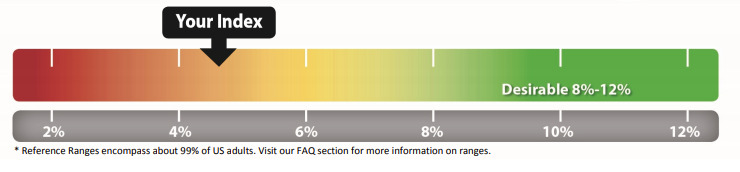


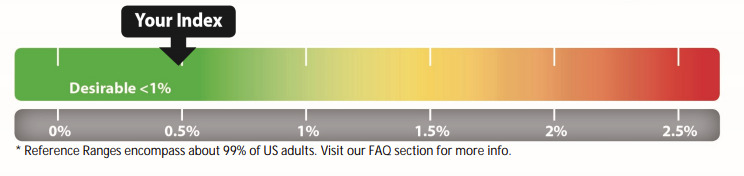
One of the best ways to make changes to your health is to have data on your body to pinpoint problem areas, motivate real change, and keep you accountable along the way. With the information provided in the omega fatty acid report and video training, you will gain the knowledge and understanding of your body to:
- Adjust the makeup of fats in your diet to support bringing your fatty acid balance back into balance so you can fight chronic inflammation, unwanted weight gain and cardiovascular in a scientific way (no more guessing!)
- Choose omega fatty acid containing foods and food-based supplements that support the health of your cells. Not just something generic off the shelf that may not be a good fit for you.
- And most importantly, give you actual data on your body to help you understand how to take back control of your health one bite at a time.
So, if you've done everything else under the sun to improve your health but are still having problems and lingering issues, it's time to address the very foundation of your body, the health of your cells!
Give all 30 trillion cell membranes you have some TLC.
Summary
- Reduce the polyunsaturated fatty acids (PUFAs) that are not evolutionarily consistent in high amounts and just say no to fake food!
- Use coconut oil to cook and bake with. Refined coconut oil is nearly flavorless, and is stable for cooking at higher temperatures, whereas virgin coconut oil is best for popcorn or desserts you are okay with having a coconut flavor.
- Use butter for lower heat cooking and baking
- Use olive oil on foods AFTER cooking (olive oil goes rancid when heated)
- Get your fatty acids tested to see where your body is at and what you really need to focus on.
Where Is Your Omega Fatty Acid Balance At?
Ready to find out your omega fatty acid balance so you can tip the scale on inflammation?
What are your favorite fats? Please share in the comments!
PIN IT:
Still not convinced? Further reading:
The Oiling of America by the Weston Price Foundation
References:
- Peat, Raymond. From PMS to Menopause: Female Hormones in Context. Eugene, OR, 1997.
- Image Credit: https://pixabay.com/images/id-1911605/
- https://omegaquant.com/publications/
- https://www.ncbi.nlm.nih.gov/pmc/articles/PMC6163829/
- https://www.ncbi.nlm.nih.gov/pmc/articles/PMC6515168/
- https://www.mdpi.com/2072-6643/8/3/128/htm


Shu Han says
great roundup on the importance of not being afraid of fat! sharing this with a friend. "think of your body as a fire, fat are the logs, carbs are kindling" nice analogy. it's not just fat-phobia these days, it's also carb-phobia. we need all these in our diet to be healthy! most of all, we just need to enjoy food in it's real, unadulterated state and stop discriminating any nutrient group.
butternutrition says
Thanks Shu! I agree. Including all of the macro-nutrients are of supreme importance for keeping our metabolism, body and mind healthy! The best diets include the greatest diversity of foods 🙂
Leal says
And not just the macro-nutrients but we need to eliminate as many chemicals from our food source that we can. Our bodies were not meant to live on chemicals.
60.242.196.158 says
you mean certain harmful chemicals like hydrogen cyanide, for example because you just cannot avoid chemicals in our food. Think of it this way: foods are complex things and a little goes a gigantic way.
also, most so called 'natural' foods are ingredients that contain little chemicals with water being a chemical itself! Examples include: bananas contain: water, glucose, fructose, sucrose, maltose, starch, glutamic acid, aspartic acid, histidine, leucine (yep, proteins are chemicals!), lysine, phenylalanine, arginine, valine, alanine, serine, glycine, threonine, isoleucine, and this is only the first 1/10th of the list of chemicals in a banana. a heart candy contains: sucrose, malic acid, stearic acid, sodium bicarbonate, starch, magnesium stearate, magnesium carbonate, anthocyanin, beetroot red dye, copper colour, curcumin, lucein and paprika for the whole entire list of heart candy chemicals! a candy has 13 chemicals wheres a banana has more than 60 chemicals.
Maartje says
how much fat do you advice (percentage)
Thanks for the info
Synovec says
Humans are heavily exposed to pesticides used by Farmers. Over time humans are getting ill of all types of sickness.Especially CANCER whether you smoke or not. Youngsters also developed CANCER. and none in families Smoked! Stay clear from soft drinks - read INGRIDIENTS AND CHECK IT OUT ! Sign off!
nancy says
hi love, very informative i have told people i work with about your site. 🙂 its great!
love you
Cindy says
We can't afford grassfed, raw butter. Is it still okay to eat store bought butter?
Catherine says
I think any butter is better than none. However, do read the ingredient list, and avoid a butter with natural flavors, and additives other than cream, salt, etc.
You can read more about butter here: https://butternutrition.com/secrets-of-butter/
Thanks for reading!
Catherine
Alyssa says
Where are you getting your sources? I was pretty sure that fish and flax seed oils are really good for inflammation. How are they bad for you? I can understand the whole mercury issue with fish oils but other than that , it's a great source of omega-3's . Just wanted to also mention I have colitis and have found that fish oil has helped me tremendously as far as inflammation goes. Please site your sources because this article bugs me.
Hema says
this is a very wrong information, though butter is good but too much consumption of saturated fats are bad for health! One should focus more on manusaturated fats & polysaturated fats which are classtified as good fats meanwhile bad fats are saturated fats and transfat
You should understand & identify the differences between good fats and bad fats. then you should know what type fats falls in which category. In this case, as I explained define above. Polysaturated fats contains omega 3&6 which is hard to find besides in fish and nuts. pumpkin nuts, seeds, etc..
Read more on them!
Alesea says
Fish oil has been proved as having anti-inflammatory effects on the body. Also the seed oils you mentioned become inflammatory because PUFA are very unstable when it comes to oxygen damage and go rancid fast. This is why it is recommended to grind the seeds just before you eat them otherwise store in the fridge but not for a long time. PUFA are great for health.
L. says
This is wrong information.
You're confusing polyunsaturated fatty acid chains with trans-unsaturated fatty acids.
Mary says
Great info - I love butter. Land of Lakes makes an AWESOME spread - the only ingredients are cream, olive oil, and salt. Just wrote a post called "Why You Need to Stop Hating On These 3 Food Groups" and linked to your post. Check it out: http://simplynatureplusnurture.com/2016/03/04/why-you-need-to-stop-hating-on-these-3-food-groups/
Bahaa al wazzan says
True info
Bravo
The mainstream media always guude people to die
Saturated fat is game
There are a good study on pigs were fed coconut oil
They got pretty lean
Thanks for sharing those amazing info
Coconut oil .is 90 percent saturated fat
For people that said fish oil or seed oil are healthy fat and they re anti inflammatory
Thats pretty wrong
Poly unsaturated fat and unsaturated fat
Mask the inflammation and suppress the immune system
So you won't feel the inflammations u have
And you re killing ur self softly
Thanks 🙂
Julie says
What's a good cooking oil alternative for those with coconut allergies?
Kassia says
Do you see any problems with using avocado oil? I use it mostly for mayonnaise since it has a neutral flavor and occasionally for cooking if I know a guest doesn't like butter or coconut oil.
60.242.196.158 says
You forgot MUFAS (Monounsaturated fats) and omega 3 fatty-acids (DHA, EPA and alpha-linoleic acid).
20 says
nothing is chemical free. a blueberry has more chemicals then a candy bar.