
I rarely ask my clients to count calories, and when I do, it's a one-time thing to make sure they are eating enough.
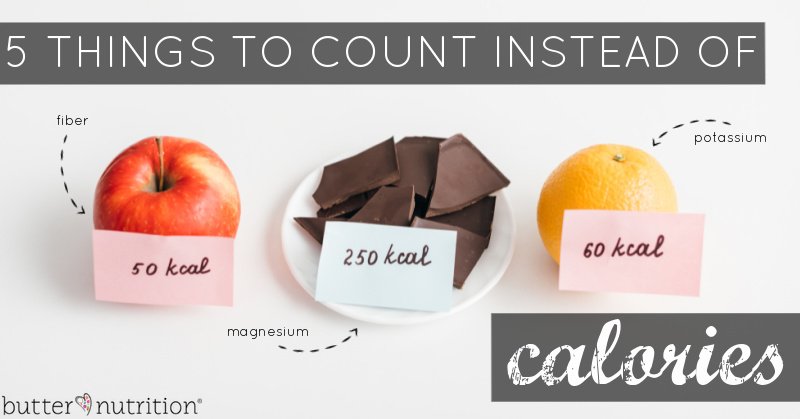
So while I'm not a fan of counting calories, if you are addicted to tracking, here are five things I find far more important to pay attention to than calories.
In fact, try focusing on one of these each week for five weeks to help you break your calorie counting habit, and I guarantee you will feel better for it.
1. Fiber
Fiber is naturally found in whole plant foods, especially in fruits, vegetables, grains and legumes. Fiber can be an incredibly important element for gut health, as fiber feeds your beneficial bacteria allowing them to thrive and keep your gut microbiome healthy.
Fiber also helps to increase fecal bulk, reducing constipation.
Most people don't get enough fiber because they simply eat too many processed foods. Women should aim for around 20-25grams of fiber per day, while men may need closer to 30-35 grams per day.
My favorite way to see if you are eating enough fiber to support a healthy gut is GI Map or stool testing. If you have low levels of beneficial bacteria, it's a key indicator that your good bacteria aren't getting the food they need to thrive.
**It's important to note that while fiber works wonders in most people I work with, there are a few that have certain genetics or gut conditions where fiber is not tolerated well. Find out what works best for you.
2. Potassium
Potassium is by far one of the most common mineral deficiencies I see in my hair tissue mineral analysis clients.
Potassium has many important roles in the body. It's a critical mineral in the body for maintaining healthy function of cells, tissues, and organs. Potassium is also an electrolyte, meaning it conducts electricity along with sodium, chloride, calcium, and magnesium in the human body. Heart, digestive, and muscular function rely on this key nutrient. In addition, healthy hormonal balance depends on potassium because it helps speed the conversion of cholesterol to progesterone.
Not getting enough potassium is typically caused by dieting (especially low carb), chronic stress (the stress response depletes potassium), and eating too many empty calories in the form of processed foods.
Aim to get around 3,500-4,700mg of potassium a day.
Testing potassium levels can be done through hair tissue mineral analysis.
3. Magnesium
Magnesium deficiency is all too common. It likely also affects you, because it's estimated that 68 to 80 percent of Americans are magnesium deficient. This should not be surprising because magnesium is needed for over 300 biochemical reactions in the body; however, it is not sufficient in the food supply, and it is also wasted by your body during times of stress.
The Recommended Dietary Allowance (RDA) of magnesium is 400-420mg for men and 310-320mg for women; these values are not getting met through the average (or even stellar) diet. According to Dr. Carolyn Dean, ND, MD, "Magnesium is farmed out of the soil much more than calcium… A hundred years ago, we would get maybe 500 milligrams of magnesium in an ordinary diet. Now we're lucky to get 200 milligrams."
Track your magnesium intake for a week or so, and see if your diet is adding up. If not, it may be time to add in some supplemental magnesium.
If you'd rather find out via testing, my favorite way to test magnesium is hair tissue mineral analysis.
4. Omega 3 Fatty Acids
Based off of the fatty testing I do with my clients, I would estimate that about 80% have an omega 3 fatty acid deficiency.
Omega 3 fatty acids are very important to make healthy cell membranes - a double layer of lipids that protect your cells (all 30 trillion cells that you have in your body) and give them their structure. Cell membranes have very important jobs to do to keep you healthy like:
- act as a gatekeeper to protect your cells from unwanted substances
- act as a gate to allow the transportation of nutrients in and allowing waste products to leave
- play an important role in cellular communication
But what if the health of your cell membranes are stiff and rigid restricting the transportation in and out due to the fats in your diet? How are your cells supposed to communicate, get nourished, and take out the trash? I mean, that's the equivalent of having a relationship where no one buys groceries, cleans, or takes out the trash and when you try to communicate with each-other you both wear earplugs. Nothing good can come out of it and it instead equates to cellular inflammation in your body.…
And remember cells create tissues, tissues create organs, and you are made up of a system of organs. If your cell membranes are compromised, the integrity of each cell, tissue and organ in your body can suffer.
So get more omega fatty acids in your diet from low-mercury sources.
Needs will vary based on genetic factors, but most people can aim for around 500mg of omega fatty acids per day.
If counting milligrams per day is not your thing, Omega Fatty Acid testing is an inexpensive way to see if what your currently getting is adequate or not.
5. Protein
Getting enough protein is necessary for achieving optimal health.
Protein is found in virtually every single part of the body and is extremely important for growth, development, detoxification, blood sugar balance, and tissue repair.
It's one of the three macronutrients, along with carbohydrates and fat. Unless you're on a low carbohydrate or low fat diet, most people don't have problems getting enough of these two, but protein can get left behind at mealtime.
Most adults need a bare minimum of 60-70grams of protein per day, but most benefit from significantly more.
Find out how much protein you need here - and count it for a few days to get an idea of what it looks/feels like.
It's pretty easy to count how much protein you're eating in a day, so I don't typically do any testing for protein. It's relatively straight to try to get a high-quality protein source in each of your meals of the day (focus on progress, not perfection).
So remember, it's not all about calories - it's what's in your calories that matters the most for how you feel. I hope this helps you break your calorie-counting habit and feel better along the way.
Do you count calories? Please share in the comments!
PIN IT:


Linda says
I would have to disagree with what you said about low carb diet if anything it encourages lots of potassium I follow Dr Berg and if anything he constantly advises people to get at least 7 to 10 cups of veg a day. He mentions potassium a lot. You could potentially put people off low carb that would otherwise benefit greatly. Having said that your article otherwise is very good and Thankyou
Catherine says
Hi Linda,
Thanks for joining the conversation. From my experience working with hundreds of clients around the world, most on low carb diets are not eating near that amount of vegetables and do not get enough potassium. I can't support diets that only work in "perfect execution' as human nature is imperfect. I also see many other issues with low carb diets.
Abundantly,
Catherine
Cristy says
I am curious about omega 3 deficiency. Ray Peat says that omega 3 fats are PUFAs, and unstable in the human body, and so I have been avoiding them. I know my diet is rich in protein, magnesium, potassium and fiber but I have been intentionally avoiding fatty cold water fish, chia seeds, flax seeds etc. Are the omega 3 fats really beneficial or harmful?
Catherine says
Hi Cristy,
I don't have blanket recommendations for omega-3s. It depends on the client, what their testing (aa:epa ratio, omega 3:6 ratio) and symptoms are. Generally speaking, I am not a big fan of omega-3 supplements, but in some cases (certain genetics, etc) they are helpful.
Abundantly,
Catherine